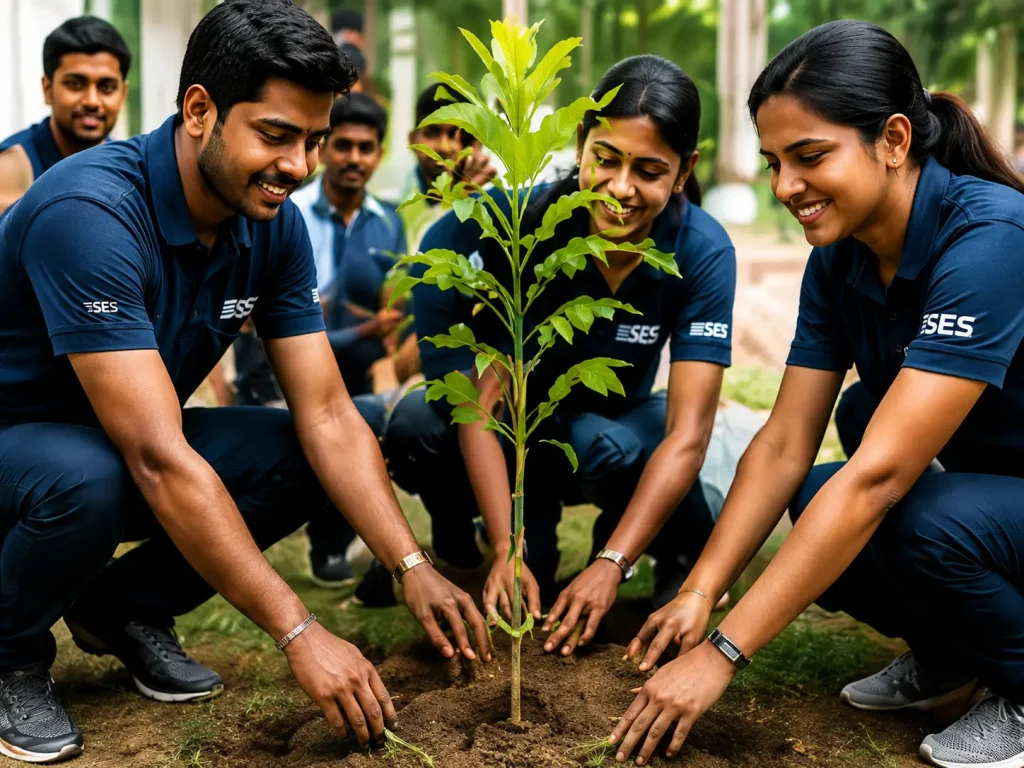
Corporate Social Responsibility
SES's Corporate Social Responsibility (CSR) framework is deeply rooted in the principle of ownership as trusteeship, reflecting a commitment to ethical stewardship, community empowerment, environmental sustainability, and long-term value creation.
Ownership as Trusteeship
SES embraces the philosophy that ownership entails responsibility—not just for profit, but for people and the planet. This aligns with Mahatma Gandhi’s concept of trusteeship, where wealth and resources are held in trust for the benefit of society. SES's ESG strategy, known as the Horizon ESG Strategy, integrates global challenges outlined in the UN's Sustainable Development Goals, focusing on four key pillars: Sustainable Space, Climate Action, Belonging, and Critical Human Needs.
Our ESG Pillars
Sustainable Space
Building responsibly for a sustainable future.
Climate Action
Committed to reducing emissions and driving clean energy.
Belonging
Creating inclusive workplaces and empowered communities.
Critical Human Needs
Supporting health, education and livelihoods for all.
Women Empowerment Initiatives
SES is committed to promoting gender equality and women's empowerment through various initiatives:
Self-Help Groups
Facilitating savings, credit access and small businesses to boost financial independence.
Skill Development Workshops
Training in tailoring, digital literacy, computer skills, handicrafts and more through trusted partners.
Legal Awareness Camps
Educating women about their rights on property, marriage, domestic violence and more.
Health Camps & Hygiene Drives
Promoting women’s health and menstrual hygiene, especially in rural communities.
Political Participation
Encouraging leadership and active participation in local governance and decisions.
UN Women's Empowerment Principles
SES-imago tag proudly adopts the UN Women's Empowerment Principles.
Educational Engagement
SES actively collaborates with educational institutions to foster learning and development:
- Student Placements: Partnering with local engineering colleges, such as the Ambala College of Engineering and Applied Research, to offer year-long placements as part of students' engineering degrees.
- Employee Education Sponsorship: Providing sponsorship programs for employees to pursue further education, including degrees and certifications, thereby promoting continuous learning and professional growth.
Sustainable Sourcing and Environmental Stewardship
In its operations, particularly concerning battery manufacturing, SES emphasizes sustainability and ethical practices:
Ethical Mining
Ensuring that materials like lithium, cobalt, and nickel are sourced from suppliers with strong environmental and labor practices.
Recycling and Reuse
Investing in technologies and processes that recycle battery materials to minimize the need for raw material extraction.
Energy Efficiency
Developing and manufacturing batteries with higher energy density and longer life cycles to reduce waste and energy consumption.
Waste Management
Implementing robust recycling programs for end-of-life batteries and ensuring proper disposal methods to minimize environmental harm.
Quality Control and Innovation:
Maintaining rigorous quality control processes and investing in research to improve battery safety features, such as thermal stability and resistance to overheating.
Transparency and Communication
Regularly publishing sustainability reports detailing environmental and social impacts, and engaging with stakeholders to address concerns and gather feedback.
Regulatory Compliance and Advocacy
Adhering to international and local regulations regarding battery safety, environmental impact, and labor practices, while supporting policies that promote responsible industry practices.
Employee Training and Development
Providing ongoing training for employees on best practices in sustainability, safety, and ethical behavior, fostering a culture of responsibility.
Customer Education
Educating customers on the proper use, maintenance, and disposal of lithium-ion batteries to extend their lifespan and reduce environmental impact.
Long-Term Vision
Setting long-term sustainability goals and continuously assessing and improving practices to align with evolving industry standards and environmental needs.